
Why Meta and Google Are Betting Big on Smart Glasses and Eyewear Partners
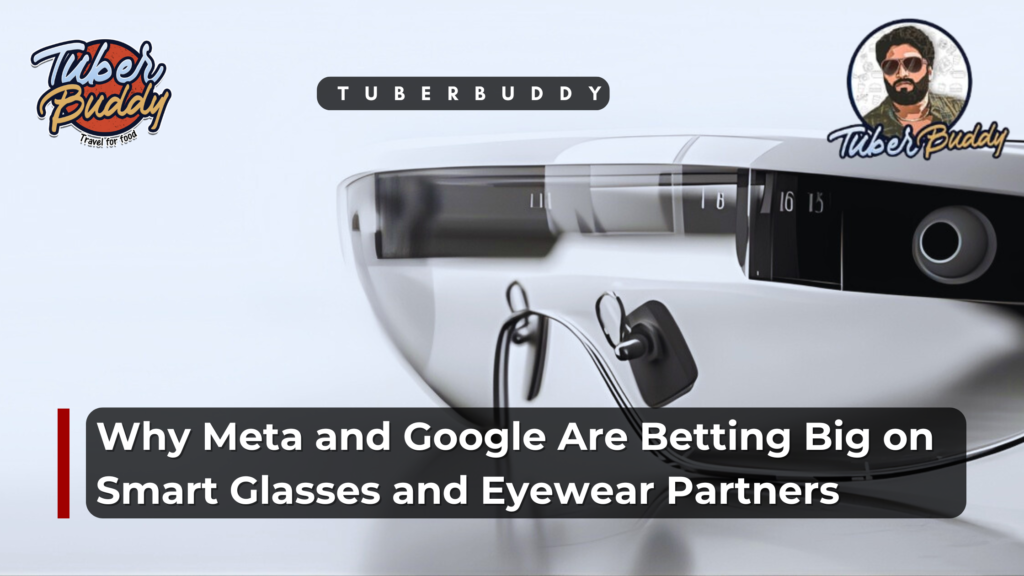
Over the past several years, the technology industry has shifted dramatically toward wearable devices; however, one of the newest and most exciting sectors of this industry is smart glasses. Originally considered an experimental product, smart glasses now represent a large part of business innovation from such large corporations as Meta and Google. The recent growth of the smart glasses market is due to changing consumer needs, advancements in technology (AI), and an overall vision of the future of human interactions with digital information.
This blog will discuss:
- What smart glasses are
- How smart glasses are growing
- Why Meta recently made an investment into EssilorLuxottica (the parent company of Rayban).
- What type of business partnerships Google is developing
- Unique characteristics of this market and how it is growing faster than ever before.
What are Smart Glasses?
Smart glasses are a type of wearable technology; they offer much more than simply the traditional style of glasses combined with technology, including cameras, sensors, speakers, AI assistants, and, in some cases, AR displays. Smart glasses complement your senses rather than being completely separated from them, as are VR headsets Smart glasses enhance your real-world experience via hands-free technology.

Why the Smart Glasses Market Is Booming
The market for smart glasses comes under the wearable technology segment, and the industry is presently expanding rapidly owing to a variety of factors.
- The Demand for Hands-Free Digital Interactions
There is an increased demand for multitasking and staying connected without having to constantly reach for smartphones. Smart glasses will enable consumers to navigate, make calls, take pictures, and access AI capabilities without interrupting daily functions. This is transforming the way users view computer interfaces.
- Advances in AR & AI Technologies
Recent technological advancements (mainly AI and AR) have greatly improved the capabilities of smart glasses. Smart glasses can provide real-time contextual information, respond to voice commands, recognize users visually, etc. These advancements have made smart glasses significantly more useful than the initial prototypes.
- Market Growth Predictions
Industry reports indicate a sharp growth in the market for smart glasses. The global smart glasses market was valued at USD 5.9 billion in the year 2024, and the market is expected to reach approximately USD 15.8 billion by the year 2035. This growth is attributed to developments in the fields of Augmented Reality (AR), Artificial Intelligence (AI), and the adoption of hand-free devices.
Currently, tech companies and traditional eyewear brands are investing heavily in smart glasses because they view this wearable technology as the next great computing platform.
Meta's Smart Glasses Strategy: Why Invest in Eyewear Leaders?
Meta has significantly contributed to making smart glasses a household item. The firm’s vision for future technology encompasses replacing monitors and other screens with the more natural, interactive, and wireless digital experiences this is also where AI-augmented glasses fit in.
Meta + EssilorLuxottica: A Strategic Partnership
When Meta invested in EssilorLuxottica the largest eyewear producer globally as well as the parent company of renowned brands like Ray-Ban and Oakley it wasn’t merely a financial gamble but rather a strategic move to get hold of hardware know-how, distribution channels, and glamour for smart eyewear.
In the year 2025, it is said that Meta made an investment that was close to $3.5 billion for a share of about 3% in EssilorLuxottica, with an option to increase that percentage later on.
However, this collaboration has already resulted in the production of consumer smart glasses like the Ray-Ban Meta series, which combines AI-enabled features such as voice activation, cameras, sound, and instant communication.
Why This Partnership Matters
✔ Eyewear Expertise: EssilorLuxottica has the know-how to create eyewear that is not only acceptable but also fashionable—a very important factor for consumer acceptance.
✔ Technology Collaboration: The strong AI and software of Meta matched with the optics and design power of EssilorLuxottica.
✔ Scale and Distribution: A partnership with an established manufacturer of eyewear fast-tracks the global distribution of smart glasses.
Their partnership has branched from the trendy Ray-Ban to the active lifestyle Oakley Meta glasses, for example.
Google's Smart Glasses Strategy: Partnerships and Platform Play
On the other hand, Google has chosen a wider partnership and platform-centric strategy, while Meta has taken a deep investment route with one major eyewear partner. The company, after previously working on products like Google Glass has changed its strategy to partnerships that utilize its software ecosystem and open standards rather than going with hardware alone.
Strategic Partnerships with Eyewear Brands
Using its Android XR platform and AI capabilities, Google is working together with brands such as Warby Parker, Kering Eyewear, and Gentle Monster to launch AI-driven smart glasses.
These alliances bring:
✔ The power of fashion and design from prominent eyewear brands
✔ Google’s software, AI, and XR platform know-how
✔ The ability for different hardware partners to produce smart glasses that are compatible with each other
To illustrate, one of the aims of a Google-Warby Parker partnership is to release featherlight AI glasses that will make use of the Android XR platform and Google’s Gemini AI by the year 2026.
Why This Model Works for Google
- Ecosystem Expansion: Rather than totally relying upon itself for hardware, Google lets different manufacturers use its software platform, which is similar to how Android operates across devices from various brands.
- Fashion + Tech Fusion: Cooperation with well-established eyewear designers guarantees that smart glasses would be fashionable and comfortable; both are very important for consumer acceptance.
This way, the consumer has a wide variety of styles and features to choose from which will lead to faster adoption. Meanwhile, the strong software foundation that will be supported by Google’s AI will be guaranteed.

Why Smart Glasses Matter Right Now
Smart glasses are becoming popular for a few reasons at this particular time:
- Presence of AI in All Fields
Generative AI has proved its worth through various actions, such as translation of languages, picture reading, providing navigation, and being a personal assistant. With smart glasses, one can wear that technology in the form of eyeglasses without looking at their mobile screen all the time.
- New Hardware and New Designs
Miniaturization of processors, better batteries, and use of light materials are the main reasons behind making the glasses of today more powerful than those of previous prototypes.
- Hands-Free Interaction Demand
For example, when people are walking and they need to navigate the right way, or they want to shoot videos from their point of view, or they just want to see the notifications, the hands-free interaction is the most user-friendly, whereas phone interaction would be inconvenient.
- Enterprise and Accessibility Use Cases
High-tech lenses are also emerging in industries like medicine, logistics, and education, they are helping workers access real-time data with no effort, which leads to more safety and less time on the clock.
Smart Glasses Competitive Landscape and Future Outlook
Smart glasses have become popular items. The production capacity of some manufacturers that aim to make millions of units per year indicates that there is a great deal of confidence in smart glasses being widely adopted.
Apple, Samsung, and even the social media platforms are reportedly working on their own wearables, which only adds to the validation that smart glasses may very well be the next big thing right after smartphones.
According to industry experts, the smart glasses category will keep on growing as the combinations of AI, AR, lightweight hardware, and fashion will together deliver cute and stylish gadgets.
If you like to know more about technology, travel, health, food and lifestyle, visit Tuber Buddy website.
Frequently Asked Questions (FAQs)
- What are smart glasses?
Smart glasses represent a kind of tech that you wear on your head as normal glasses do, but, at the same time, they include features like cameras, speakers, and AI. Users can benefit from the hands-free access to the digital information, and in some cases the augmented reality visuals are even shown.
- Why are Meta and Google pouring money into smart glasses?
The two firms regard smart glasses as the next big computing platform that could possibly eliminate or lessen the reliance on smartphones. They want to transform digital human interactions into something very natural, smooth, and practically inseparable from the real-life scenario through the combination of hands-free AI and augmented reality.
- Why did Meta choose Ray-Ban’s parent company EssilorLuxottica as its partner?
The tech giant teamed up with the largest eyewear maker to produce smart glasses that are chic, comfy, and suitable for daily wear. The combined proposal of Luxottica’s fashion skills and Meta’s technology and AI produces the items that consumers are more likely to adopt on a large scale.
- Why is Google a partner and not a suitor when it comes to eyewear brands?
Google is applying a platform-oriented strategy like the one used for the Android operating system for smartphones. By tying up with different eyeglass makers such as Warby Parker and Gentle Monster, Google is able to not only sell different designs but also to make a huge smart eyewear ecosystem that is powered by its AI and Android XR innovations.
- What factors have made the smart glasses market grow so rapidly right now?
AI, AR, miniaturized hardware, and digital technology have advanced so much that smart glasses are now practical and cool to wear. The customers are always looking for the quickest way to get information without the need for constant screen gazing—smart glasses are the perfect solution to that.