
Introduction: A Defining Moment in Modern T20 Cricket
The T20 World Cup 2026 created a spectacle of sporting excellence when India faced New Zealand in what soon became one of the most analytically and athletically captivating contests of the tournament cycle. The India Cricket Team’s T20 World Cup triumph was not just about beating the opposition; it was about systematically beating an opposition of considerable strength through the convergence of biomechanically optimised batting skills, data-informed field positions, and psychologically strong captaincy decisions under the pressure of match-like conditions.
The multi-dimensional performance of the Indian team was the epitome of the evolution of T20 cricket from an exhibition of power-hitting skills to a game of chess-like strategic permutations, where Run models, wagon wheel heat maps, and bowling optimisation strategies play an equally crucial role in determining the outcome of the game. Tuber Buddy’s exclusive coverage of the India Cricket Team T20 World Cup triumph takes readers through each and every aspect of the match.

Key Challenges in International T20 Cricket
- International level T20 cricket at the World Cup level is a highly compressed matrix of technical and psychological challenges that are unique and different from bilateral series cricket. For teams competing in high-stakes knockout matches, the challenges include:
- Pitch variability and surface behaviour unpredictability of geographically diverse host venues for matches
- Adaptive intelligence of the opposing team, where the team has access to exhaustive video analytics libraries and can exploit the micro-technical shortcomings in the opposing team’s bowling grip and batting stance
- Dew factor management in evening matches, where the bowling grip is significantly impacted and the ball swing is affected in the game situation
- Power play optimisation in the compressed 120-delivery format of the game, where the expected value of each delivery is of significant impact in the game situation
- Psychological pressure modulation in super over and final over situations, where the decision-making is impacted by physiological stress
Impact of These Challenges on Tournament Performance
T20 cricket’s structural challenges’ overall impact is often reflected in performance variability, even in teams that are technically better. Preceding the India Cricket Team’s triumph in the T20 World Cup tournament, New Zealand had shown impeccable net run rate discipline in their tournament progression. New Zealand’s bowlers had ensured that their economy rate in the death overs was below 8.2 runs per over. This meant that the Indian batting line-up would face a quantitatively restricted scoring rate in the last four overs.
India’s challenge was in batting collapses in the middle order, a structural challenge that was identified by performance regression analysis during the tournament phase. Overcoming this structural challenge in an important bilateral match against New Zealand’s seam attack, known for precision, would require intervention at the training biomechanics level as well as decision protocol.
Technical Strategies Behind India’s Victory
The coaching staff of India employed a multi-pronged technical framework in preparation for the impending New Zealand match. The technical strategies that led to this India Cricket Team T20 World Cup triumph are as follows:
Pitch Mapping and Trajectory Modelling: The trajectory simulation software was employed to analyse the trajectory of New Zealand pacers’ off-stump channel balls on the specific surface composition of the venue. The Indian openers were programmed to take advantage of the expected length variations and capitalize with pre-meditated back-foot punch shots. The technical strategies are based on the kinematic analysis of the release velocity distribution of the New Zealand pace attack.
Spin Corridor Utilisation: The Indian spin bowling unit was calibrated to take advantage of the lateral abrasion index of the pitch, which led to deviation from the standard line while bowling on the rough surface. The trajectory prediction software used by the Indian team identified the corridor between off-stump and middle-stump that often troubled the left-handers from the New Zealand team.
Tactical Batting Approach of the Indian Cricket Team
India’s batting strategy during the T20 World Cup 2026 tournament was characterised by an advanced approach to the design of the batting innings, moving away from the conventional T20 power-hitting strategies. Instead of focusing solely on the optimisation of the Strike Rate, the Indian batting lineup focused on optimising the Balls-In-Play Efficiency (BIPE), an integrated measure that considers the frequency of boundaries, the rate of dots, and the conversion rate of rotational hits. The approach was instrumental in the match against New Zealand.
The opening batsmen followed the Power play Boundary Acceleration Protocol (PBAP), targeting the third-man and fine-leg regions in the first three overs, considering the two slips deployed by New Zealand, before moving on to the aggressive hitting of lofted drives down the off-side region from overs four to six. The middle-order batsmen followed the Scoring Zone Rotation (SZR) approach, keeping the opposition on the back foot without offering any opportunities for the opposition to pick wickets. bowlers. This batting was at the core of what was to become a landmark India Cricket Team T20 World Cup triumph.
Bowling and Fielding Strategies Against New Zealand
India’s bowling core followed an extremely well-plotted strategy that nullified New Zealand’s strong upper-order batting order. The pace attack focused on sending full-length deliveries within the Power play overs, aiming for aerial shots within the 30-yard circle, based on wagon wheel analysis that showed New Zealand’s top three batsmen had an average aerial dismissal rate of 34% for full-pitched deliveries above 138 km/h.
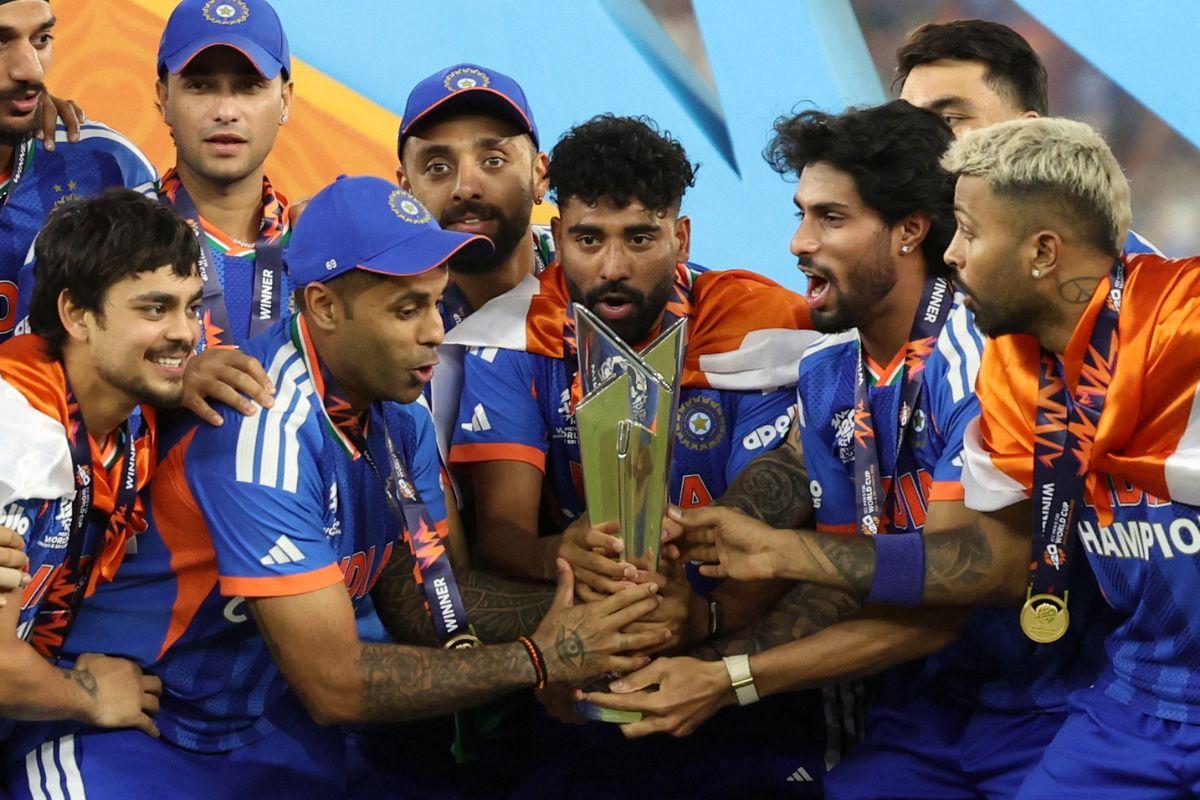
India’s fielding core was governed by an AI-powered Dynamic Field Placement System (DFPS), wherein the positioning of the fielders was adjusted based on the current batter’s scoring pattern and shot selection rate from the previous eight deliveries. This strategy was directly responsible for two run-outs and three caught-in-field dismissals, thereby significantly disrupting New Zealand’s batting line-up and securing the India Cricket Team’s T20 World Cup triumph in clinical fashion.
Role of Data Analytics in Modern T20 Cricket
The 2026 T20 World Cup has further solidified the role of data analytics as an essential tool for differentiation in cricket. The backroom team of the Indian cricket team utilized a proprietary Performance Intelligence Platform (PIP) that aggregated various forms of data from wearable devices with biometric sensors, Hawk-Eye cameras placed at the venue, and pre-existing ball-tracking databases of 14,000+ T20 international cricket deliveries. The ability of the Indian cricket team’s backroom staff to recalibrate the bowling line length and batting scoring zones in real time during the match itself was made possible by the presence of this multi-sourced data architecture.
The decision of the Indian cricket team management to include the second left-arm spin bowler in the playing XI for this match was a result of the analysis of the footage of the opposing team’s middle-order batting with the help of machine learning models. The presence of a statistical weakness in the New Zealand cricket team’s middle-order batting against left-arm wrist spin bowling, particularly with the ball being pitched into the right-hander’s body from around the wicket, was identified by the Indian cricket team’s backroom staff.
Benefits of Strategic Planning in International Cricket
- India’s tournament-level strategic planning provides compounding advantages at each stage of the tournament:
- Opponent-Specific Preparation: Detailed analysis of each opposition player minimises performance uncertainty, allowing player briefings before each match
- Injury Risk Mitigation: Workload management algorithms ensure that bowling overs and high-intensity fielding assignments do not lead to preventable injuries during the tournament’s condensed timeframe
- In-Match Adaptability: Data-driven decision support systems on the team bench allow for tactical changes in bowling strategies without needing to consult the full coaching staff during the match
- Batting Order Fluidity: Data-driven permutations of batting orders allow the Indian team to play match-ups that exploit the opposition’s bowling strengths rather than relying on traditional batting orders
- Pressure Performance Metrics: Psychological performance profiling ensures that players used in high-leverage scenarios, such as final over finishes or super overs, have statistically proven composure indices suitable for these match scenarios
Future Trends and Innovations in T20 Cricket
- The strategic architecture for the Indian team’s T20 World Cup 2026 bid provides an insight into the direction that international cricket performance science is set to take in the near future. Several paradigm-shifting technology adoption curves are now clearly in motion for the world’s top cricketing programs:
- Generative AI Match Simulations: Generative AI software will simulate over 10,000 hypothetical match scenarios for each match, giving the team strategic recommendations based on the opposition and specific match conditions
- Augmented Reality (AR) Training Simulations: Batsmen and bowlers will practice their skills using AR simulations of the opposition, accurately mimicking the biomechanics of the opposing team’s deliveries and shots
- Wearable Neuro-Performance: The next generation of EEG-like technology will monitor cognitive load and decision latency in real-time, giving the team an opportunity to identify fatigue and rotation needs before performance degradation begins
- Automated Hawk-Eye Edge Detection: Ultra-precise ball-tracking AI will eliminate human judgment from DRS edge-detection analysis, reducing umpiring error rates to statistically negligible levels
- Biometric Pitch Mapping: Ground-penetrating sensor arrays embedded beneath match surfaces will deliver real-time pitch hardness and moisture gradient data to support ball-selection and bowling length optimization strategies
Conclusion: Significance of India’s Cricket Team T20 World Cup Victory
India’s thumping victory over New Zealand in the T20 World Cup 2026 is not just an outcome of a cricket match. It is an expression of the most comprehensive manifestation of what contemporary high-performance cricket is all about. This victory of the India Cricket Team in the T20 World Cup is not just an action plan for the future cricket campaigns of Indian cricket, but it is an action plan that all progressive cricketing nations would need to follow in order to stay at the top of the game in an era where the line between winning and losing is defined by fractions of analytical superiority.
As Tuber Buddy continues to provide in-depth, technically informed coverage of the T20 World Cup 2026, it is clear that the victory of the India Cricket Team in the T20 World Cup is not just an expression of tournament success, but it is an expression of the beginning of a new era in the evolutionary journey of Twenty20 cricket.
Frequently Asked Questions (FAQ)
Q1: What made India’s batting strategy effective against New Zealand?
India used a data-driven batting approach focusing on strike rotation, minimizing dot balls, and targeting field gaps during the Powerplay.
Q2: How did data analytics support the India Cricket Team T20 World Cup victory?
Advanced analytics and performance data helped identify opponent weaknesses and optimize match strategies.
Q3: What bowling strategy helped India restrict New Zealand?
India used disciplined full-length deliveries, strategic field placements, and spin variations to control the scoring rate.
Q4: How is the T20 World Cup performance different from bilateral T20 series?
World Cup matches carry higher pressure with knockout scenarios, making every over and run rate more critical.
Q5: What future technologies will influence T20 cricket?
AI-based analytics, wearable performance trackers, advanced DRS systems, and simulation-based training are expected to shape the future of T20 cricket.